How to Set Up a Backgammon Board
The standard starting position uses the same simple 2–5–3–5 pattern for both players. This guide shows where every checker goes and which way each side moves.
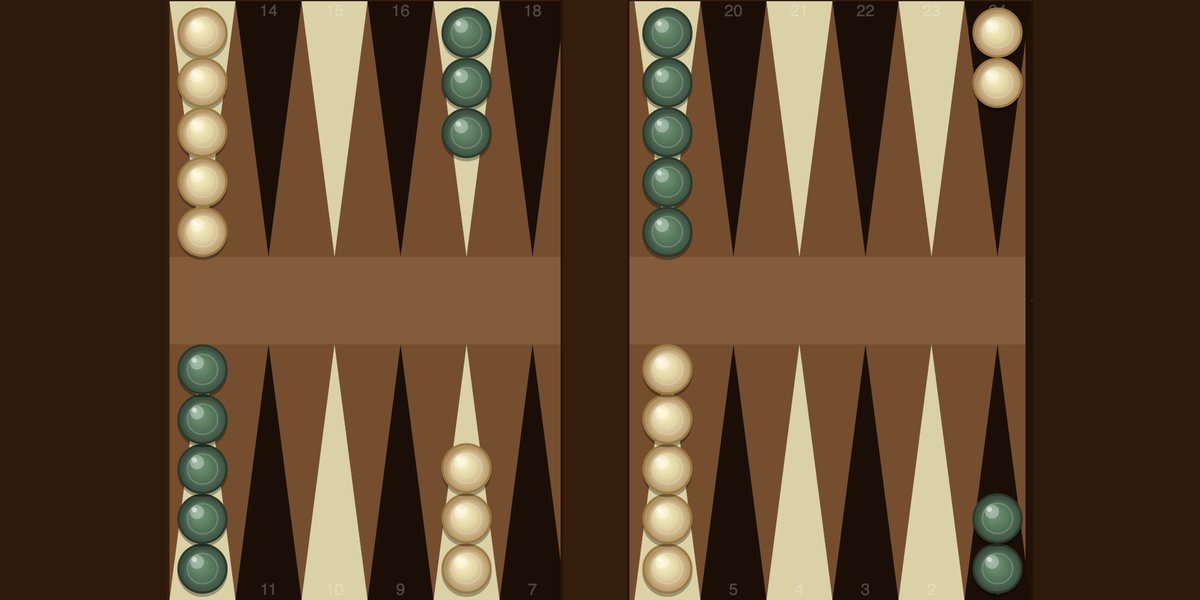
The 2–5–3–5 Starting Position
Every standard backgammon game begins with 15 checkers per player. The checker colors do not have fixed positions: choose a color, then place that player's checkers using the four stacks below.
Your 15 checkers
- 2 on your 24-point
- 5 on your 13-point
- 3 on your 8-point
- 5 on your 6-point
Your opponent's 15 checkers
- 2 on their 24-point
- 5 on their 13-point
- 3 on their 8-point
- 5 on their 6-point
Point Numbers and Movement Direction
A backgammon board has 24 narrow triangles called points. Each player numbers the points from their own perspective, so your 1-point is your opponent's 24-point.
Your checkers move from higher numbers toward lower numbers: 24 → 23 → … → 2 → 1 → off. The two players move in opposite directions around the board. Before play begins, confirm that both colors travel toward their own home boards rather than following each other.
Set Up the Board Step by Step
- Place the board between the two players with the bar running down the center.
- Choose checker colors and decide which home board belongs to each player.
- Place two of your checkers on the farthest point, your 24-point.
- Place five on your 13-point, on the far side of the board just beyond the bar.
- Place three on your 8-point and the final five on your 6-point.
- Mirror the same arrangement for the other color.
- Put both pairs of dice within reach. Place the doubling cube to one side showing 64 or centered between the players.
To verify the setup, count each color: every player must have exactly 15 checkers, and no checker starts on the bar or in a bear-off tray.
Common Setup Mistakes
Both players moving in the same direction
The arrangements are mirrored because players move in opposite directions. Each player should move toward the home board on their own side.
Reversing the three- and five-checker stacks
The 8-point has three checkers; the 6-point has five. Remember that the larger stack begins inside your home board.
Counting points from one player's perspective
Point numbers are relative. A physical triangle can be your 1-point and your opponent's 24-point at the same time.
Starting with checkers on the bar
The bar begins empty. Checkers go there only after they are hit during the game.
Frequently Asked Setup Questions
- Does checker color determine who moves first?
- No. Each player rolls one die; the higher roll goes first and uses both opening dice.
- Which side is the home board?
- Either orientation is valid as long as the players have opposite home boards and move in opposite directions. Many boards put each player's home board on the side nearest them.
- Where does the doubling cube start?
- Place it midway between the players or to the side with 64 facing up, indicating that neither player owns the cube and the game is worth one point.
- Is the Tavla starting setup different?
- Standard Turkish Tavla uses the same checker arrangement. Some match, cube, and bearing-off conventions can differ; see the Tavla vs. Backgammon guide.
Learn the Next Step
Once the board is ready, learn the best first move for each roll, or open a game and use the starting position in practice.